
The warm winter and resulting lack of snowpack are top of mind for many Coloradans, especially for those worrying about facing drought conditions in the coming months.
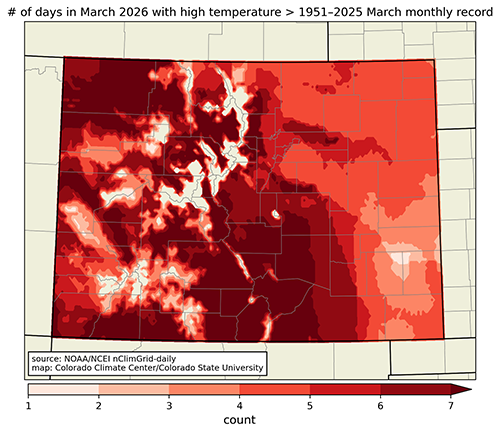
According to the most recent measurements from the Colorado Climate Center at Colorado State University, 2026 is likely to be worst year in recorded history for Colorado’s snowpack. April 1 is a key date for measuring snow water equivalent (SWE), or the amount of liquid water stored in the snow. These measurements help climate scientists determine the state’s water supply. This year, Colorado’s average SWE across 115 measurement sites on April 1 was 3.3 inches. Typically, the SWE measures around 15 inches on April 1. This year’s historic lows are largely due to the winter’s low precipitation and a record-breaking heatwave in March.
Most of Colorado’s water originates as snow or rain, so the state government closely monitors water supplies to manage water use. This year’s low snowpack is compounded by a dry spring and summer in 2025, leading to drought conditions across the state. In response, Governor Polis activated Phase 2 of Colorado’s Drought Response Plan and the Drought Task Force. The Drought Response Plan is outlined in the larger Colorado Enhanced State Hazard Mitigation Plan, 2023-2028. Phase 2 includes a likelihood that water use restrictions will be imposed to preserve the state’s water supply. To stay updated on drought conditions, check out the data and graphics in the Drought & Surface Water Supply Index, which is frequently updated by the Department of Natural Resources.
As we face our current drought, it is helpful to look back on the lessons learned during past droughts – as an arid state, Colorado has made it through many! A history of drought in Colorado, published by the Colorado Climate Center, provides an overview of why Colorado is prone to drought and lessons in water management that have been learned during previous droughts. During one of history’s most destructive droughts in the 1930s, the Agricultural Experiment Station published several pamphlets to educate farmers on the best methods to preserve and improve their farmland. Finally, the Colorado State University Extension has published many resources for Coloradans managing drought in their gardens or farms, including a guide to help emotionally cope with drought that is especially useful for those whose livelihoods depend on agriculture.

- Impact of wildfire smoke on Colorado’s air quality - June 12, 2026
- Colorado State Parks: Staunton - May 29, 2026
- West Salt Creek Landslide - May 15, 2026