
Brief Bio:

David Grann (born March 10, 1967) is an American journalist and #1 New York Times bestselling author, widely considered a master of modern narrative non-fiction. A staff writer for The New Yorker since 2003, Grann has built a reputation as a “workhorse reporter” known for his deep immersion into forgotten histories, cold cases, and tales of extreme survival. His work is characterized by a “you-are-there” immediacy and a commitment to uncovering the truth behind some of history’s most baffling mysteries. His books frequently explore the darker side of human nature, the complexities of justice, and the sheer power of the elements.
Born in Connecticut, Grann comes from a literary background; his mother, Phyllis Grann, was the first woman CEO of a major publishing firm (Putnam Penguin). He graduated from Connecticut College in 1989 with a BA in Government and later earned master’s degrees in international relations from Tufts University and creative writing from Boston University.
Before finding his home at The New Yorker in 2003, Grann worked as a copy editor at The Hill later becoming the executive editor in 1995. In 1996, Grann became senior editor at The New Republic. He has written for the New York Times Magazine, The Atlantic, The Washington Post, The Wall Street Journal, and The Weekly Standard.
He lives in New York with his wife and two children, continuing to write for The New Yorker while developing his next historical deep-dives.
Available Works in the Colorado Book Club Resource
The Book Club Resource has 8+ copies of each title available for 8 weeks at a time to reading groups across the state. Descriptions below taken from Amazon.com.
The Lost City of Z: A Tale of Deadly Obsession in the Amazon (2009) | Discussion Questions
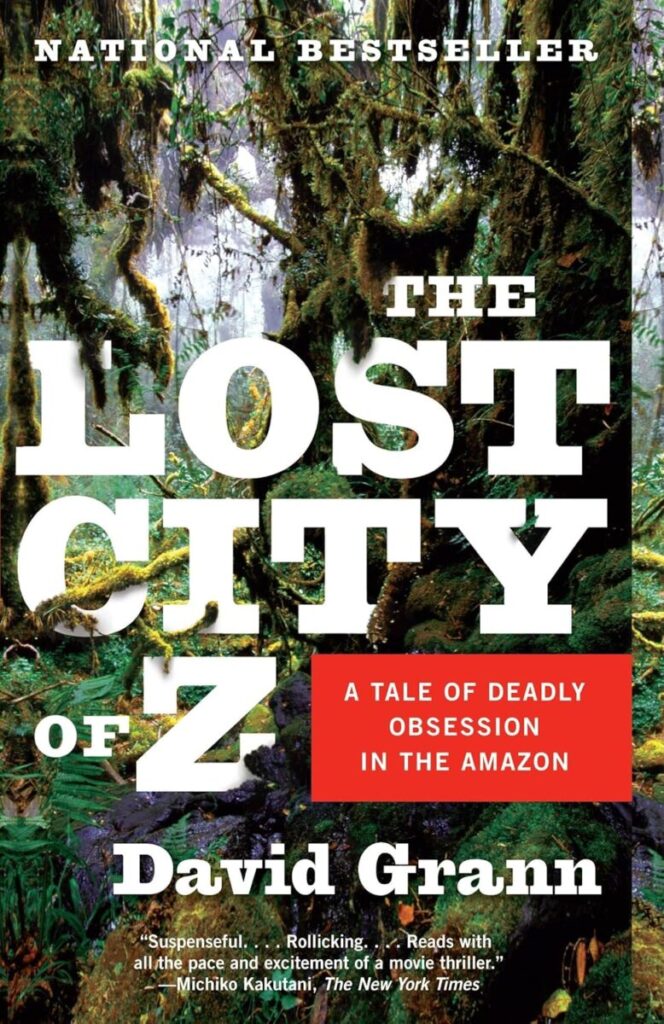
After stumbling upon a hidden trove of diaries, acclaimed writer David Grann set out to determine what happened to the British explorer Percy Fawcett and his quest for the Lost City of Z. For centuries Europeans believed the Amazon, the world’s largest rain forest, concealed the glittering kingdom of El Dorado. Thousands had died looking for it, leaving many scientists convinced that the Amazon was truly inimical to humankind. In 1925 Fawcett ventured into the Amazon to find an ancient civilization, hoping to make one of the most important discoveries in history. Then he vanished. Over the years countless perished trying to find evidence of his party and the place he called “The Lost City of Z.”
In this masterpiece, journalist David Grann interweaves the spellbinding stories of Fawcett’s quest for “Z” and his own journey into the deadly jungle.
Killers of the Flower Moon: The Osage Murders and the Birth of the FBI (2017) | Discussion Questions
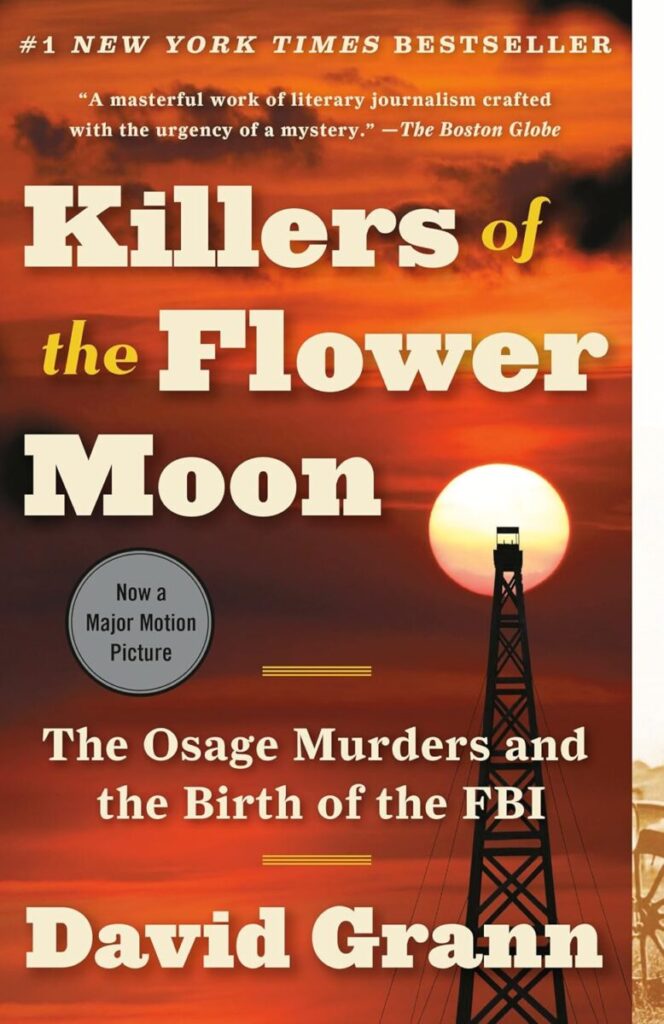
In the 1920s, the richest people per capita in the world were members of the Osage Nation in Oklahoma. After oil was discovered beneath their land, the Osage rode in chauffeured automobiles, built mansions, and sent their children to study in Europe.
Then, one by one, the Osage began to be killed off. The family of an Osage woman, Mollie Burkhart, became a prime target. One of her relatives was shot. Another was poisoned. And it was just the beginning, as more and more Osage were dying under mysterious circumstances, and many of those who dared to investigate the killings were themselves murdered.
As the death toll rose, the newly created FBI took up the case, and the young director, J. Edgar Hoover, turned to a former Texas Ranger named Tom White to try to unravel the mystery. White put together an undercover team, including a Native American agent who infiltrated the region, and together with the Osage began to expose one of the most chilling conspiracies in American history.
The Wager: A Tale of Shipwreck, Mutiny and Murder (2023) | Discussion Questions
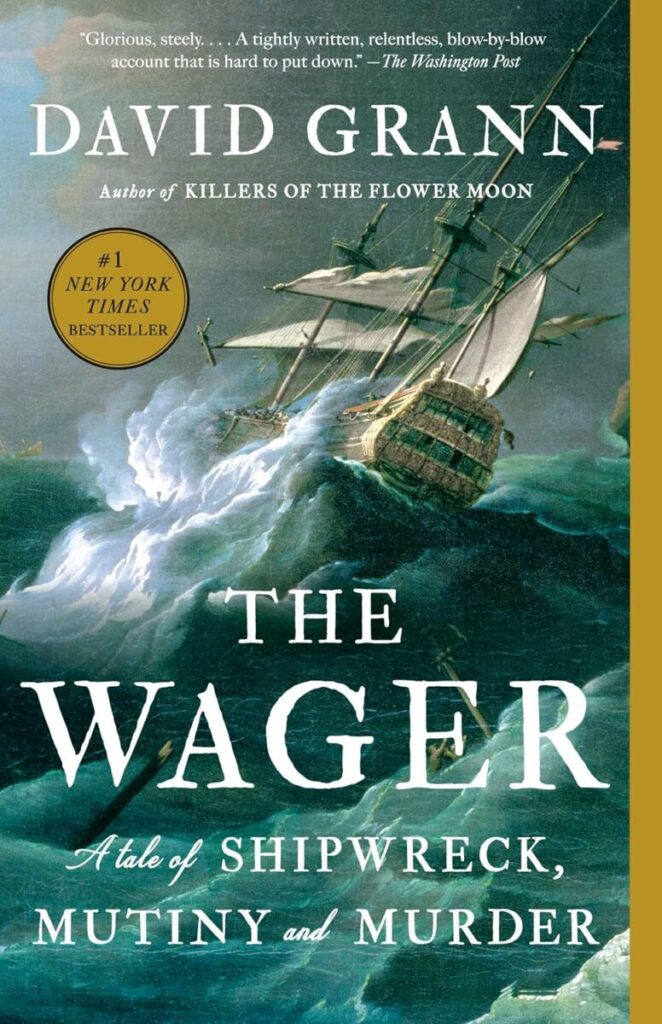
On January 28, 1742, a ramshackle vessel of patched-together wood and cloth washed up on the coast of Brazil. Inside were thirty emaciated men, barely alive, and they had an extraordinary tale to tell. They were survivors of His Majesty’s Ship the Wager, a British vessel that had left England in 1740 on a secret mission during an imperial war with Spain. While the Wager had been chasing a Spanish treasure-filled galleon known as “the prize of all the oceans,” it had wrecked on a desolate island off the coast of Patagonia. The men, after being marooned for months and facing starvation, built the flimsy craft and sailed for more than a hundred days, traversing nearly 3,000 miles of storm-wracked seas. They were greeted as heroes.
But then … six months later, another, even more decrepit craft landed on the coast of Chile. This boat contained just three castaways, and they told a very different story. The thirty sailors who landed in Brazil were not heroes – they were mutineers. The first group responded with countercharges of their own, of a tyrannical and murderous senior officer and his henchmen. It became clear that while stranded on the island the crew had fallen into anarchy, with warring factions fighting for dominion over the barren wilderness. As accusations of treachery and murder flew, the Admiralty convened a court martial to determine who was telling the truth. The stakes were life-and-death—for whomever the court found guilty could hang.
The Wager is a grand tale of human behavior at the extremes told by one of our greatest nonfiction writers. Grann’s recreation of the hidden world on a British warship rivals the work of Patrick O’Brian, his portrayal of the castaways’ desperate straits stands up to the classics of survival writing such as The Endurance, and his account of the court martial has the savvy of a Scott Turow thriller. As always with Grann’s work, the incredible twists of the narrative hold the reader spellbound.
Notable Facts:
- David Grann is often described as “the man Hollywood can’t stop reading.” A staff writer for The New Yorker since 2003, he has mastered the art of “narrative nonfiction”—true stories that read like high-stakes thrillers.
- While researching Killers of the Flower Moon, Grann essentially disappeared from the public eye. Between 2012 and 2017, he didn’t publish a single article in The New Yorker. He spent those years digging through archives and visiting the Osage Nation to piece together the “reign of terror” that had been largely scrubbed from American history books.
- Despite writing about explorers in the Amazon (The Lost City of Z) and shipwrecks in Patagonia (The Wager), Grann describes himself as a “landlubber” who is prone to motion sickness and prefers the safety of a library. He often jokes about his lack of survival skills, yet he famously retraced Percy Fawcett’s steps through the Amazon jungle—nearly dying of various tropical ailments in the process.
- The seed for Killers of the Flower Moon was planted when Grann visited the Osage Nation Museum and saw a panoramic photograph from 1924. A large section had been cut out. When he asked why, the museum director told him, “The devil was standing right there.” The missing piece contained the image of William Hale, the mastermind behind the Osage murders. This mystery sparked Grann’s five-year investigation.
- Before becoming a nonfiction titan, Grann tried his hand at fiction. He eventually realized that he struggled with creating plots and dialogue from scratch. He found his “superpower” in excavation: finding real-life stories that were more unbelievable than anything he could invent and applying his creative writing training to reconstruct them.
- Grann’s office is often described as a chaotic archive. For The Wager, he didn’t just read accounts of the shipwreck; he traveled to the desolate “Wager Island” off the coast of Chile to understand the landscape.
- While researching the Osage murders, he found a random ledger in a box of government records that proved the conspiracy was far larger than the FBI ever realized—revealing that many more people were involved in the killings than the “official” history suggested.
- Almost everything Grann writes is optioned for film. Notable adaptations include:
- Killers of the Flower Moon: Directed by Martin Scorsese, starring Leonardo DiCaprio.
- The Lost City of Z: Directed by James Gray, starring Charlie Hunnam.
- The Old Man & the Gun: Starring Robert Redford (based on Grann’s New Yorker article).
- The Wager: Currently in development with Scorsese and DiCaprio attached again.
Quotations:
- “I’d rather find the story and excavate it than make it up. I think of myself as an excavator. You aren’t imagining the story—you are excavating the story.”
- “I often look for the one-inch brief in a newspaper that I find alluring and hints at something. I think maybe there’s a deeper story in that… The story isn’t going to come to you if you’re just sitting around. It’s an active process.”
- “The way we live history is not the way historians tell history. Our lives are messy and chaotic and bewildering.”
- “There’s a tendency when we write history to do it with the power of hindsight and then assume almost god-like knowledge that nobody living through history has.”
- “Stories and narratives are always the way I try to make sense of the world… I think it’s interesting how reality can blend into myth and fiction—and how we tell these stories can shape us as people, and shape us as nations.”
- “I am not, by nature, an explorer or an adventurer. I am a landlubber. I’m most suited for combing through library stacks and archives.”
- “Research is difficult from a physical level… Writing is more emotionally difficult. That’s the one you really struggle psychically. Every once in a while you have a really good day writing.”
- “My nightstand is more like a geological structure: a bunch of books piled on the floor with its own strata.”
- “I spend my life mostly disproving conspiracies.”
Awards & Recognition:
- 2017: National Book Award Finalist – Killers of the Flower Moon
- 2018: Edgar Allan Poe Award for Best Fact Crime – Killers of the Flower Moon
- 2023: Barnes & Noble Book of the Year – The Wager
- 2024: Andrew Carnegie Medal for Excellence in Nonfiction (Longlisted) – The Wager
Videos/Interviews:
- How to Write Something Truly Memorable – How I Write with David Perell (Youtube 2025)
- Why David Grann’s office looks like a research archive itself – 60 Minutes (Youtube April, 2023)
- Authors David Grann and Ben Macintyre share their approaches to writing narrative history – writer’s room, penguin Random House (Youtube September, 2024)
- David Grann Reacts to Film Adaptation of his Book KILLERS OF THE FLOWER MOON – Penguin Random House (Youtube August, 2024)
- Author David Grann on Two Month Amazon Expedition to Research “The Lost City of Z” – C-SPAN (Youtube November, 2025)
- David Grann on Covering Politics on Capitol Hill, Conversations with Dicaprio & Scorsese, & More – Dedicated with Doug Brunt (Youtube February 2025)
- America’s Book Club: David Grann – C-SPAN (YouTube November, 2025)
- Largely Forgotten Osage Murders Reveal A Conspiracy Against Wealthy Native Americans – NPR Fresh Air interview.
- David Grann, the master of literary investigation who’s busy seducing Hollywood – Le Monde (April 17, 2023)
- David Grann uncovered a real-life “Lord of the Flies” – BookPage.com (May, 2023)
- David Grann answers questions about his book, The Lost City of Z: A Tale of Deadly Obsession in the Amazon – BookBrowse.com
Resources:
Book club sets are circulated to participating libraries via the CLiC courier. Read all about the program on the Book Club Resource landing page. If you are interested in receiving book club sets but are not already a member library, use the online form to get signed up.
Since the BCR has always relied on book donations, we are deeply grateful to all of the institutions and individuals that have donated sets and helped make the collection stronger. Please contact [email protected] for questions or to discuss donations..
.png)
- Book Club Author Suggestion: Maggie O’Farrell - June 3, 2026
- Book Club Author Suggestion: David Grann - May 5, 2026
- From Prompts to Partners – The Art of the AI Workflow - April 16, 2026