
Through the summer and early fall, butterflies can be spotted all around Colorado, including at high elevations. It’s estimated that nearly 300 butterfly species call Colorado home at some point in the year, although some species are just briefly migrating through on their way to warmer climates.
Along with bringing more color to the Colorado skies, butterflies are important pollinators and help ensure the success of our wildflowers and agricultural systems. Butterflies feed off nectar from flowers using a straw-like feeding apparatus called a proboscis. During their feeding sessions, butterflies can transport pollen from flower to flower.
Butterflies are so important to Colorado that one was named Colorado’s official State Insect: the Colorado hairstreak. The hairstreak and four others are described in detail in Insects of Interest, a series published by the Colorado State University Extension.
Colorado hairstreak
The Colorado hairstreak became the Official Insect of the State of Colorado in 1997 due to the efforts of fourth grade classes across the state. Colorado hairstreaks feature bright purple wings, a color similar to another state symbol, the columbine. The butterflies can be seen throughout Colorado between June and August. They tend to congregate in areas with Gambel oaks, the hairstreak’s host plant. The Gambel oak trees are important to the Colorado hairstreak’s lifecycle; they lay eggs on the trees’ twigs in the winter, the larvae feed on oak leaves in the spring, and they use the trees as shelter to pupate in late spring and early summer before emerging as adult butterflies.
Painted lady
The painted lady is a large, orange-and-black butterfly that can migrate through Colorado in large numbers when the weather is favorable. These butterflies are nearly always in motion as they search for warm weather and food (they’re particularly fond of thistles). Because of their migratory habits, painted ladies are the most widely distributed butterfly in the world and can be found in North America, South America, Africa, Europe, and Asia.
Mourning cloak
Although they have a somber name, mourning cloak butterflies have some of the longest lifespans of any butterfly, living up to 11-12 months. They live longer than other butterfly species because of their ability to survive the cold winter in diapause, which is a period of slowed growth and inactivity. Mourning cloaks are named for their dark purple coloring. Their wings have a distinctive pale-yellow border and blue spots along the edge.
Black swallowtail
The black swallowtail butterfly is a large, primarily black butterfly with different markings on males and females; males have a yellow band along the edge of their wings, while females have a row of yellow spots and iridescent blue markings. Black swallowtails are mostly found in Colorado’s eastern plains where they search for food in yards and open fields. The larvae of the black swallowtail are called “parsleyworms” because they are often found chowing down on garden dill, parsley, and fennel plants.
Two-tailed swallowtail
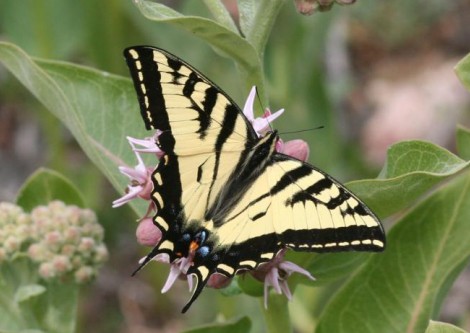
The two-tailed swallowtail is one of the largest butterflies that can be found in the state, with a wingspan that can reach up to 5 inches. Their wings are mostly yellow with black striping and iridescent blue dots along the bottom edge. Two-tailed swallowtails are named for their distinctive “tails” that project off the bottom of their hindwings. These butterflies are found throughout the state but are commonly found in areas with ash trees or chokecherry trees.

- Impact of wildfire smoke on Colorado’s air quality - June 12, 2026
- Colorado State Parks: Staunton - May 29, 2026
- West Salt Creek Landslide - May 15, 2026