
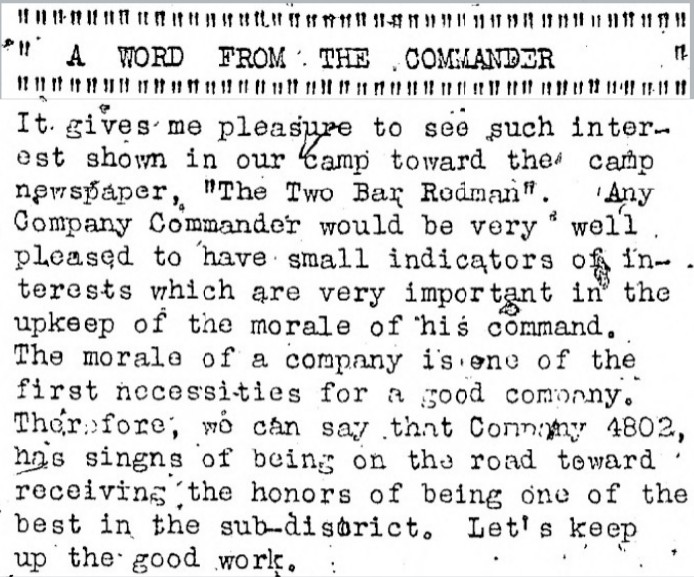
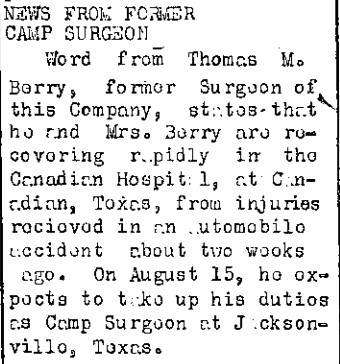
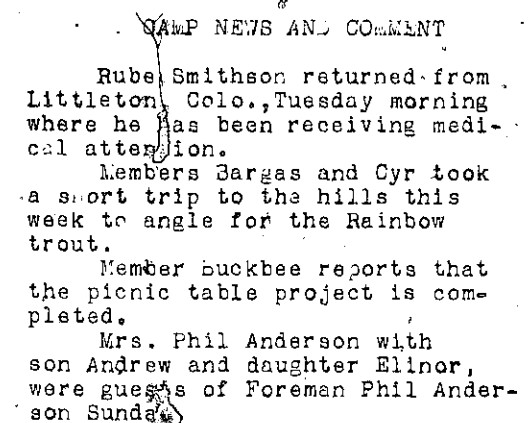
The CHNC team at the Colorado State Library recently added 52 Civilian Conservation Corps (CCC) Camp newspapers to the CHNC online collection. During the life of the CCC program, 172 Colorado camps employed about 32,000 young men, the majority of whom were state residents. Major Colorado projects included building the Red Rocks Amphitheatre, constructing roads and trails in national parks, planting trees, and managing forest health. The Camp newspapers, often mimeographed by enrollees, contain a mix of daily camp life, work project updates, humor, poetry, and personnel changes. They served as local news sources for the company, documenting sports, educational classes, and social events.
The Civilian Conservation Corps (CCC), initially named the “Emergency Conservation Works”, was a massive New Deal work relief program established by President Franklin D. Roosevelt on April 5, 1933. Patterned on a similar program he led in New York, the CCC aimed to reduce unemployment among young men while conserving the nation’s depleted natural resources. Within months of its establishment, the federal government, coordinating with the Departments of War, Labor, Agriculture, and Interior, quickly established over 1,400 working camps by July 1933, putting 300,000 single, male U.S. citizens between the ages of eighteen and twenty-five to work. The program reached its peak in the summer of 1935 with over half a million men across approximately 2,900 camps.
Structure and Compensation
The program’s administrative structure involved the Labor Department handling recruitment, while the War Department (Army) managed the men’s administration, transportation, housing, food, clothing, medical care, and discipline in a military-camp fashion. Enrollees were paid $30 a month, with a stipulation that at least $22, and often $25, be sent directly to their dependents. Although life in the camps was spartan, accommodations offered basic comforts, such as running water, electricity, and heat, that many of the impoverished youth did not have at home. While the program gave young men work experience and provided essential income for families, it excluded women and enrolled minority men at rates far lower than allowed by legislation.
National and Local Projects
CCC crews were assigned to the departments of Interior and Agriculture, working for agencies like the National Park Service, U.S. Forest Service, U.S. Bureau of Reclamation, and State Parks. Across more than 800 public lands nationwide, their conservation work included planting millions of seedlings, constructing trails, roads, and campgrounds, building picnic structures, and carrying out fire prevention and historic preservation. Though prolific, some projects were based on the environmental knowledge of the time and later improvements in science proved them to be detrimental to the landscapes.
Impact in Colorado
The CCC had a profound impact on Colorado, contributing an estimated $56 to $63 million to the state’s depressed economy and assisting greatly in conservation efforts. Over the program’s lifespan, approximately 32,000 young men, mostly state residents, found employment across 172 camps. Camps focused on badly needed improvements, including building roads, trails, and campgrounds, planting millions of seedlings, and performing vital fire suppression services. Major accomplishments included infrastructure building in national parks and monuments like Rocky Mountain National Park, Mesa Verde National Park, and Colorado National Monument. On the eastern plains, camps completed soil and water erosion control projects resulting from overgrazing and drought. The CCC also provided assistance to the Bureau of Reclamation on irrigation projects in areas like Uncompahgre, Grand Valley, and Mancos.
Red Rocks Amphitheatre
One of the best-known achievements of the CCC in Colorado was the construction of the Red Rocks Amphitheatre near Morrison, which was a stellar example of Federal and local government collaboration. The site’s history stretches back to 1878, when it was known as the “Garden of the Angels,” before being purchased by the City and County of Denver in 1928 and renamed “Park of the Red Rocks”. Using President Roosevelt’s New Deal programs, Denver officials, led by George Cranmer, obtained CCC approval to construct the monumental amphitheater—an expenditure that would have otherwise seemed frivolous during the Depression.
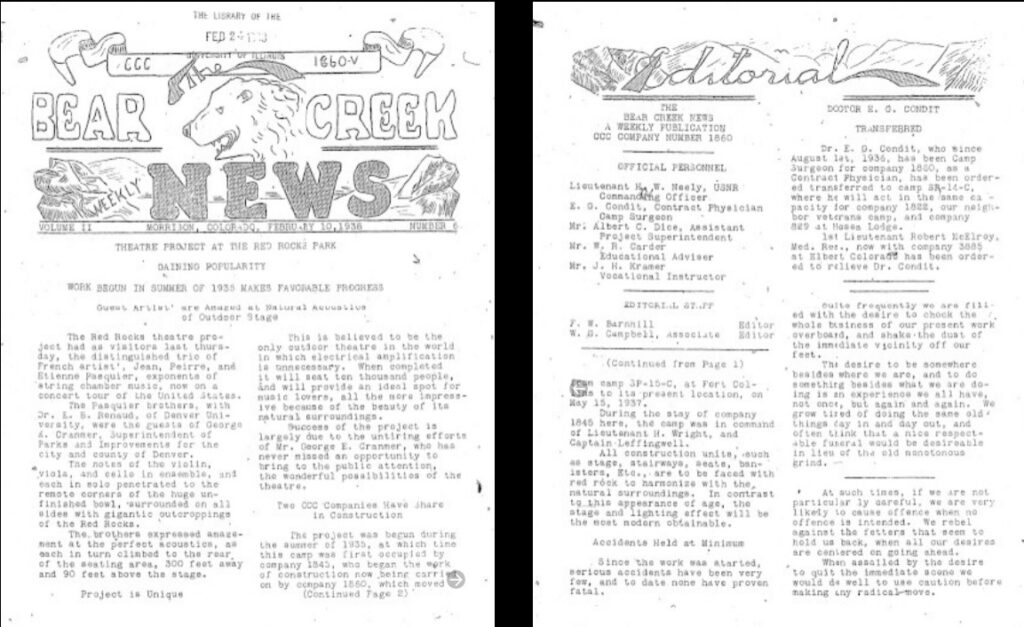
Housed at the Mount Morrison CCC Camp (Camp SP-13-C), approximately 200 enrollees from Company 1848 arrived in June 1935. U.S. Secretary of the Interior Harold Ickes approved the project on May 9, 1936, and work began two days later on “Project No. 120”. This became one of the largest and most difficult CCC projects of its kind in the entire nation. Construction required:
- Removing 25,000 cubic yards of dirt.
- Using ten carloads of cement, 800 tons of quarried stone, and 90,000 square feet of flagstone.
- Creating an 80 x 170 foot stage, an orchestra pit, large dressing rooms, and a huge tiered seating area for 10,000 people, resulting in 12,000 square feet of floor space.
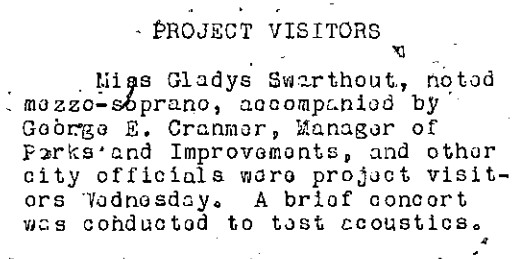
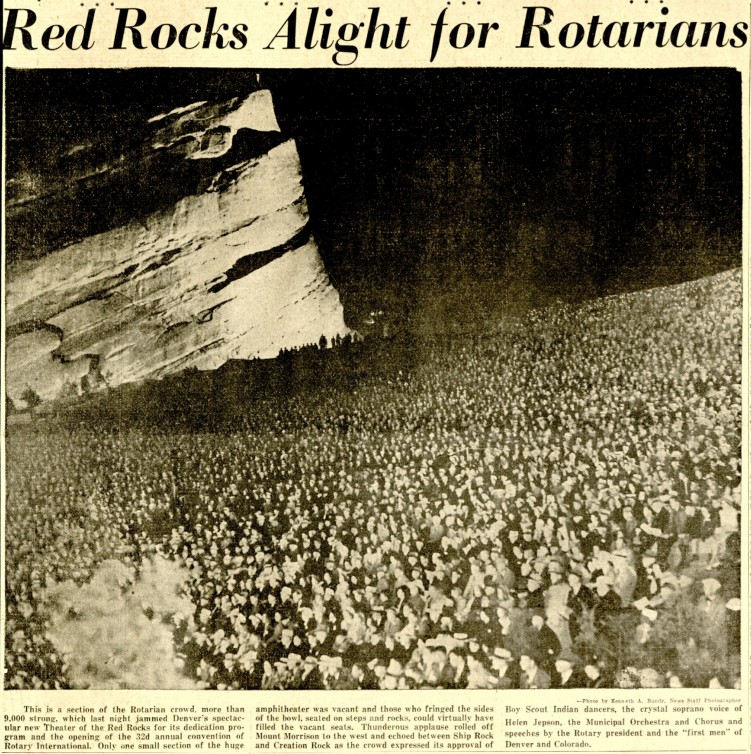
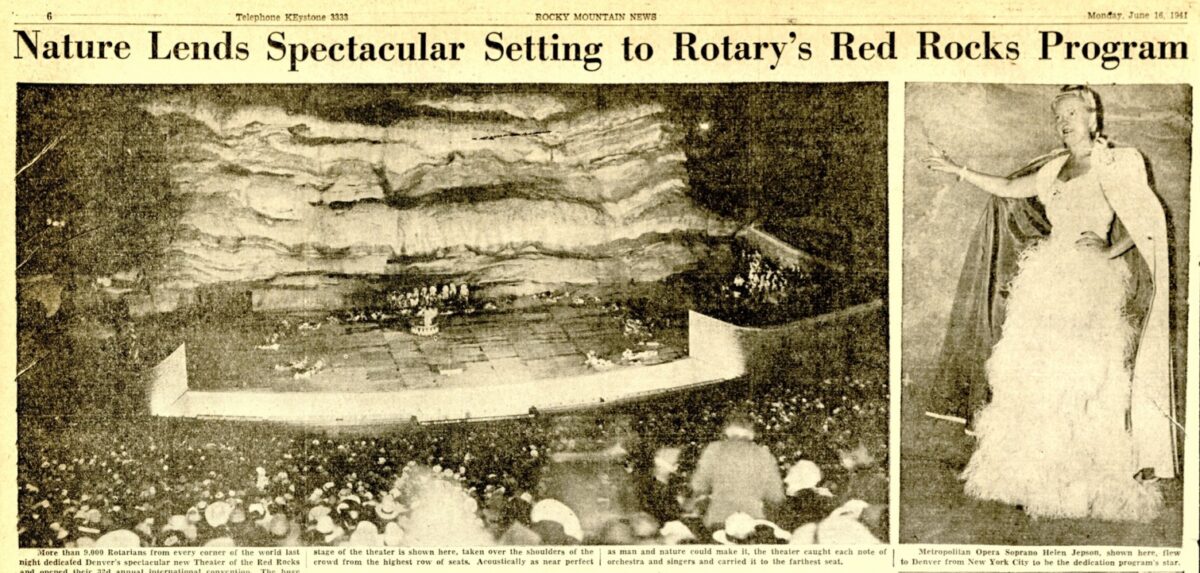
The grand opening was held on June 15, 1941, featuring speeches from the Governor and Mayor and a concert by Metropolitan Opera star Helen Jepson.
Funding for the CCC was discontinued on June 30, 1942, when Congress voted to liquidate the program due to the nation’s focus on World War II. The remaining 60,000 enrollees were released. After the program ended, some camps were transferred to the military or used to house conscientious objectors, war prisoners, or Japanese evacuees. Today, the legacy of the corps lives on in infrastructure projects across the country, and the Mount Morrison camp remains one of the few intact examples of a CCC camp in the United States.
Additional Resources
- Website, Colorado Civilian Conservation Corps: Remember in the CCC Heritage in Colorado. https://coloradoccc.org
- Article, Civilian Conservation Corps, Colorado Encyclopedia. https://coloradoencyclopedia.org/article/civilian-conservation-corps
- Articles, CCC History, National Park Service. https://www.nps.gov/colm/learn/historyculture/ccc-history.htm

- The United Farm Workers in Colorado: Huelga! - May 4, 2026
- Life in Camp: Colorado Civilian Conservation Corps Camp Newspapers - April 17, 2026
- Recording: Elephind Webinar – Explore the Future of Newspaper Research - November 20, 2025
I don’t know why I was fortunate enough to get this in my email, but thank you. I live in Karval. Our community building began life as a CCC barracks in Hugo. In the future it will be fun for me to look at the information you have on file for the Hugo camp. Thanks again.
I am also interested in information, especially photographs, of the Kansas Pacific Railroad, later the Union Pacific. The Hugo Roundhouse is being revitalized and I would love to have good old photos of the original building and other local whistle stops. If somebody could give me advice or a contact name on that project I would really appreciate it.
Keep up the good work.
I’m so glad you enjoyed this article! To start take a look at this search of the CCC camp papers, https://www.coloradohistoricnewspapers.org/?a=q&r=1&results=1&e=——-en-20-grp%3ACCC+Camp+papers-81–img-txIN%7CtxCO%7CtxTA-hugo——-0——. There are many mentions of Hugo. You might want to also browse the title, The Dam-an-Furrow, the paper for the Hugo camp, https://www.coloradohistoricnewspapers.org/?a=cl&cl=CL1&sp=DAF&e=——-en-20–1–img-txIN%7CtxCO%7CtxTA——–0——. We have 91 issues, November 15, 1935 – June 28, 1940, for that title.
For historic photographs, I would suggest starting with a search of this website, https://ppc.dp.la. This site is an aggregation of historic collections held by institutions in Colorado and Wyoming. There is a great photograph of the original Hugo Hospital held by the Denver Public Library!