
Brief Bio:
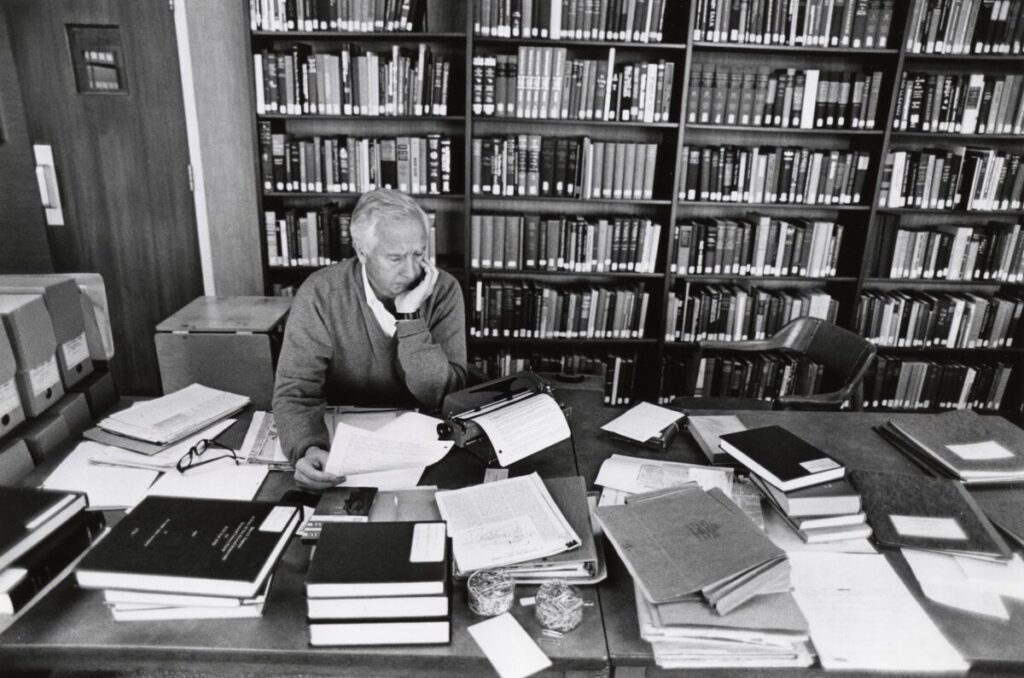
David McCullough was an acclaimed American historian, biographer, and narrator, widely regarded as the “master of the American narrative.” Born on July 7, 1933, in Pittsburgh, Pennsylvania, McCullough grew up with a deep appreciation for literature, architecture, and the arts. He drew heavily on his passion for storytelling and deep archival research to transform historical figures and engineering marvels into vivid, humanized epics that resonated with millions of everyday readers.
McCullough earned a Bachelor of Arts in English from Yale University, graduating in 1955. Though he initially harbored ambitions of becoming a playwright or portrait artist, his early career working as a writer and editor for Sports Illustrated, Architectural Forum, and the United States Information Agency ignited a lifelong fascination with historical research. His academic foundation in literature, rather than academic historiography, heavily influenced his uniquely character-driven approach to non-fiction.
David McCullough’s writing consistently explores themes of human character, perseverance, leadership, and the unpredictable nature of history. His works are celebrated for their meticulous research and seamless blend of political biography with rich social history, bringing a deep psychological insight to legendary American moments and people. McCullough’s storytelling is characterized by its lyrical prose, optimistic perspective, and accessibility, making him a monumental figure who bridged the gap between academic history and popular literature.
In addition to his writing, David McCullough was a respected voice in broadcasting. He was a familiar presence on television as the long-time host of PBS’s American Experience and the narrator of numerous high-profile documentaries, including Ken Burns’s landmark series The Civil War. He was an ardent advocate for historical literacy, lecturing at universities and before Congress to preserve the legacy of America’s founding principles. He passed away on August 7, 2022, leaving behind an indelible impact on how Americans engage with their own past.
Available Works in the Colorado Book Club Resource
The Book Club Resource has 8+ copies of each title available for 8 weeks at a time to reading groups across the state. The descriptions below were adapted from standard publisher summaries.
1776 (2005) | Discussion Questions
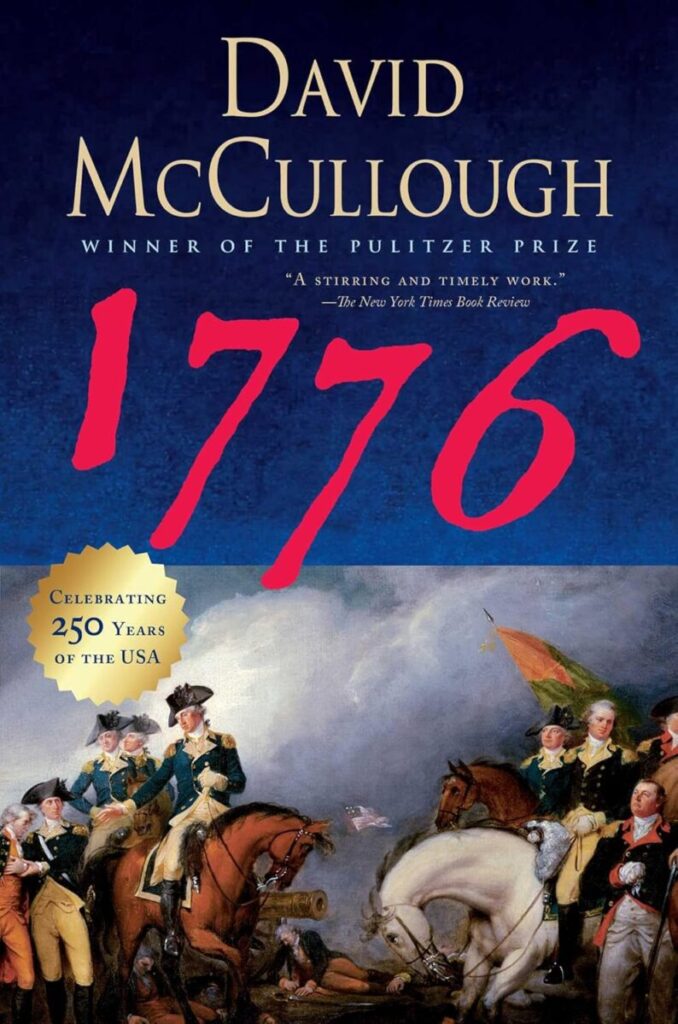
In this masterful book, David McCullough tells the intensely human story of those who marched with General George Washington in the year of the Declaration of Independence—when the whole American cause was riding on their success, without which all hope for independence would have been dashed and the noble ideals of the Declaration would have amounted to little more than words on paper.
Based on extensive research in both American and British archives, 1776 is a powerful drama written with extraordinary narrative vitality. It is the story of Americans in the ranks, men of every shape, size, and color; farmers, schoolteachers, shoemakers, no-accounts, and mere boys turned soldiers. And it is the story of the King’s men, the British commander, William Howe, and his highly disciplined redcoats who looked on their rebel foes with contempt and fought with a valor too little known.
The American Spirit: Who We Are and What We Stand For (2017) | Discussion Questions
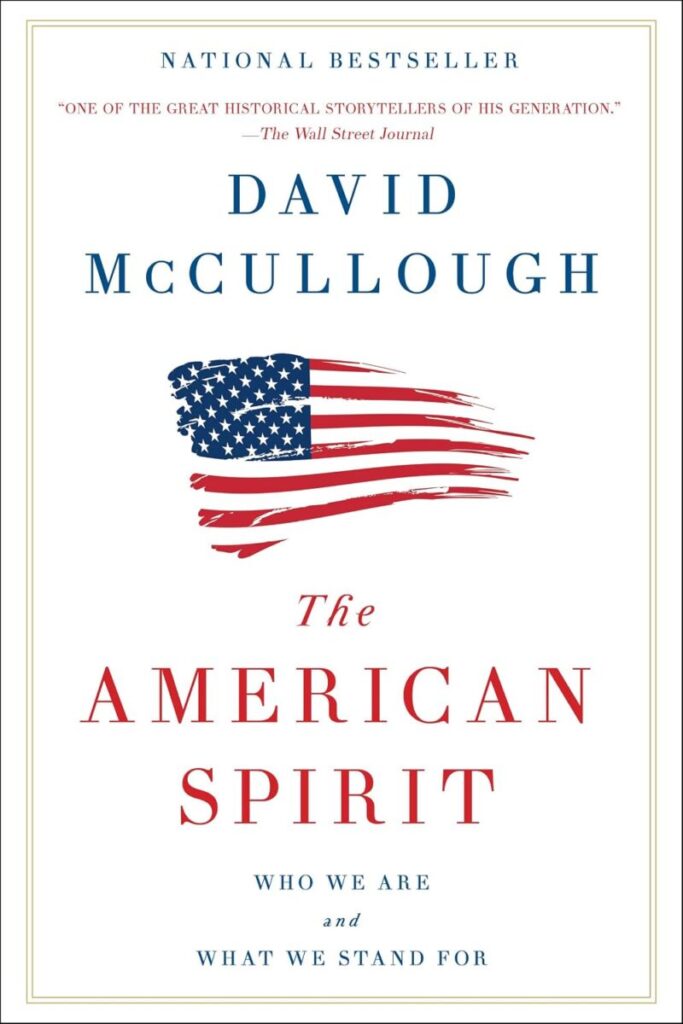
“Insightful and inspirational, The American Spirit summons a vexed and divided nation to remember—and cherish—our unifying ideas and ideals” (Richmond Times-Dispatch). Over the course of his distinguished career, McCullough has addressed Congress, the White House, universities, and historical institutions across the country. Now, in an era of self-reflection following a divisive political season, he brings together these stirring speeches in a powerful volume celebrating civic duty, American character, and historical perspective.
“The American Spirit is as inspirational as it is brilliant, as simple as it is sophisticated” (Buffalo News). McCullough reminds us of the values that unite us as Americans—regardless of region, political affiliation, or background. This is a book of history, hope, and reflection that speaks directly to readers seeking wisdom, unity, and a deeper connection to the ideals that define the United States.
The Pioneers: The Heroic Story of the Settlers Who Brought the American Ideal West (2019) | Discussion Questions
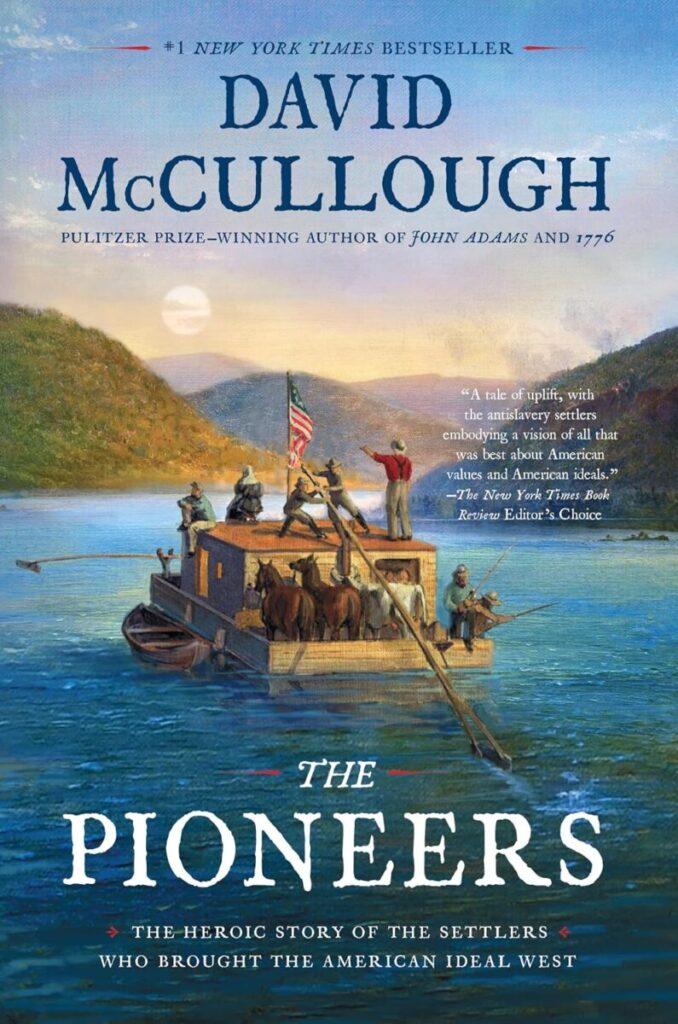
As part of the Treaty of Paris, in which Great Britain recognized the new United States of America, Britain ceded the land that comprised the immense Northwest Territory, a wilderness empire northwest of the Ohio River containing the future states of Ohio, Indiana, Illinois, Michigan, and Wisconsin. A Massachusetts minister named Manasseh Cutler was instrumental in opening this vast territory to veterans of the Revolutionary War and their families for settlement. Included in the Northwest Ordinance were three remarkable conditions: freedom of religion, free universal education, and most importantly, the prohibition of slavery. In 1788 the first band of pioneers set out from New England for the Northwest Territory under the leadership of Revolutionary War veteran General Rufus Putnam. They settled in what is now Marietta on the banks of the Ohio River.
McCullough tells the story through five major characters: Cutler and Putnam; Cutler’s son Ephraim; and two other men, one a carpenter turned architect, and the other a physician who became a prominent pioneer in American science. “With clarity and incisiveness, [McCullough] details the experience of a brave and broad-minded band of people who crossed raging rivers, chopped down forests, plowed miles of land, suffered incalculable hardships, and braved a lonely frontier to forge a new American ideal” (The Providence Journal).
Drawn in great part from a rare and all-but-unknown collection of diaries and letters by the key figures, The Pioneers is a uniquely American story of people whose ambition and courage led them to remarkable accomplishments. “A tale of uplift” (The New York Times Book Review), this is a quintessentially American story, written with David McCullough’s signature narrative energy.
Coming Soon!
History Matters (2025) | Discussion Questions
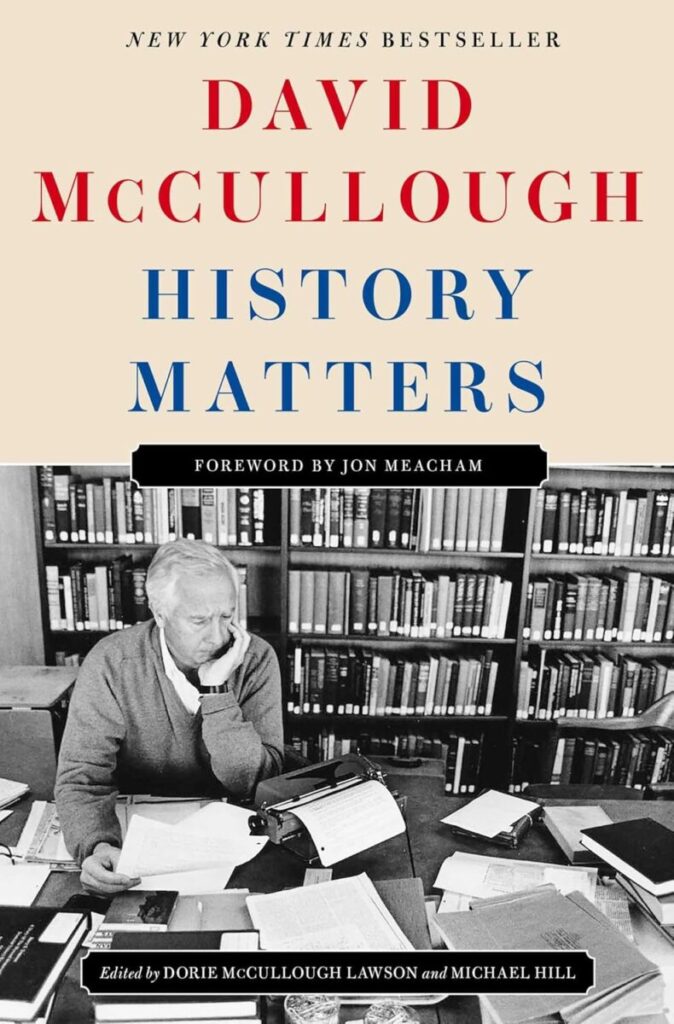
History Matters brings together selected essays by beloved historian David McCullough, some published here for the first time, written at different points over the course of his long career but all focused on the subject of his lifelong passion: the importance of history in understanding our present and future. Edited by McCullough’s daughter, Dorie McCullough Lawson, and his longtime researcher, Michael Hill, History Matters is a tribute to a master historian and offers fresh insights into McCullough’s enduring interests and writing life. The book also features a foreword by Jon Meacham.
McCullough highlights the importance of character in political leaders, with Harry Truman and George Washington serving as exemplars of American values like optimism and determination. He shares his early influences, from the books he cherished in his youth to the people who mentored him. He also pays homage to those who inspired him, such as writer Paul Horgan and painter Thomas Eakins, illustrating the diverse influences on his writing as well as the influence of art.
Rich with McCullough’s signature grace, curiosity, and narrative gifts, these essays offer vital lessons in viewing history through the eyes of its participants, a perspective that McCullough believed was crucial to understanding the present as well as the past. History Matters is testament to McCullough’s legacy as one of the great storytellers of this nation’s history and of the lasting promise of American ideals.
And There’s More…
Check out our other titles relating to US and Colorado history. Discussing these works in your book club is a great way to celebrate the 250/150 summer fun.
- America 250/Colorado 150
- Based in Colorado
- Colorado Authors
- Indigenous Peoples/Native American/American Indian Literature
- Asian American and Pacific Islander (AAPI) Books
A Few Notable Facts:
- McCullough was awarded the Presidential Medal of Freedom in 2006, the United States’ highest civilian honor.
- He never used a computer or a word processor; he wrote every single one of his books on a manual 1940 Royal typewriter that he purchased secondhand in 1965.
- His interest in writing history was sparked entirely by accident when he came across a collection of old photographs of the devastating 1889 Johnstown Flood at the Library of Congress, which inspired his first book.
- Known for his deep immersion into his subjects, McCullough walked the paths, read the exact books, and visited the same locations his historical figures frequented to properly capture their world.
- His distinctive, resonant baritone voice was so highly regarded that he was often described by critics as “The Voice of America.”
- Over his lifetime, McCullough received two Pulitzer Prizes, two National Book Awards, and over 40 honorary college degrees.
- He married his wife, Rosalee Barnes, in 1954, and they remained happily married for 68 years until her passing, just two months before his own death in 2022.
Selected Quotations:
- “Real education is the work of a lifetime, and the more you know, the more you want to know.”
- “History is a human story. It’s about people. It’s about things that happened to real people in real places.”
- “No harm’s done to history by making it something that someone would actually want to read.”
- “If we don’t know our history, we don’t know who we are, or what we should be doing, or where we are heading.”
- “There is no such thing as a self-made man or woman. We are all shaped by those who came before us.”
- “We think we live in difficult times—and we do—but they lived in times that were much more difficult, and they didn’t know how it was going to turn out.”
- “A nation that forgets its past can function no better than an individual with amnesia.”
- “I’m drawn particularly to stories that evolve out of the character of the protagonist.”
- “Every book is a new journey. I never felt I was an expert on a subject as I embarked on a project.”
Awards and Recognition
- 1978: The Path Between the Seas – National Book Award for History (Winner); Francis Parkman Prize (Winner).
- 1993: Truman – Pulitzer Prize for Biography (Winner); Colonial Dames of America Annual Book Award (Winner).
- 2002: John Adams – Pulitzer Prize for Biography (Winner).
- 2006: Recipient of the Presidential Medal of Freedom, presented by President George W. Bush.
- 2016: Appointed an Officer of the Legion of Honor by the French government for his work on Franco-American history (The Greater Journey).
Sources
- Wikipedia
- National Endowment for the Humanities (NEH)
- Brainy Quote
- YouTube
- David McCullough: the 60 Minute Interview
- David McCullough’s Most Satisfying Research Project (Charlie Rose)
- Historian David McCullough on “The American Spirit” – CBS This Morning
- Remembering the life and work of Pulitzer Prize-winning historian David McCullough – PBS News Hour
- David McCullough Reflects on a Life of Writing and Learning
- Historian David McCullough on His Craft (Charlie Rose)
Book club sets are circulated to participating libraries via the CLiC courier. Read all about the program on the Book Club Resource landing page. If you are interested in receiving book club sets but are not already a member library, use the online form to get signed up.
Since the BCR has always relied on book donations, we are deeply grateful to all of the institutions and individuals that have donated sets and helped make the collection stronger. Please contact [email protected] for questions or to discuss donations.
.png)
- Book Club Author Suggestion: David McCullough - July 2, 2026
- Book Club Author Suggestion: Maggie O’Farrell - June 3, 2026
- Book Club Author Suggestion: David Grann - May 5, 2026