
Ginger Williams is the State Health Education Specialist and Healthy Aging Assistant Professor for the CSU Extension Office. Sue Schneider is an Extension Professor and State Health Specialist for the CSU Extension Office. They’ve answered some questions below to help librarians around Colorado learn about the CSU Extension Offices located all over the state.

Tell us who you are and what you do at your organization:
CSU Extension is part of the Office of Engagement and Extension. Extension delivers research-driven programs and resources through county offices statewide, offering expertise in agriculture, youth development, health, and natural resources to support and enrich Colorado communities.
How can your organization partner with a library to offer resources or programming to the local community of library visitors and users?
If libraries would like to partner with a local Extension office, they should call the specific office in their county and inquire what programs Extension might be able to offer in their library.
CSU Extension is growing their repertoire of healthy aging programs available statewide. These programs include:
Advancing Healthy Aging Webinar Series – features topics identified by communities across Colorado. Libraries can recommend these webinars to their patrons. Libraries can also host watch parties in their spaces to bring patrons together and have robust discussions with one another on the topics, creating opportunities for social connection and peer support.
Aging Mastery Program (AMP)– A robust, comprehensive, evidence-based prevention program targeted for people 50 and over to learn about a variety of aging topics to live healthy lives offered through National Council on Aging (NCOA). The program’s unique features include access to local health experts, peer support, robust social connection and cultural adaptations to meet the needs of diverse communities. Frequently, AMP graduates go on to continue meeting regularly with their fellow alumni and participating in additional learning opportunities which can include cultural and nature-based events around the community. These strong group bonds have lasted for several years for some groups. This program has been implemented across Colorado in over 20 counties.
A Matter of Balance – Evidence-based fall prevention program designed to reduce fear of falling and increase physical activity. Through small group workshops led by trained coaches, participants learn to shift their mindset to view falls as controllable, set realistic goals for activity, make environmental changes to reduce risks, and practice exercises to improve strength and balance. CSU Extension has one master trainer who can facilitate train-the-trainer sessions, based on levels of demand.
Building a Community Legacy Together – Intergenerational program focused on older adults passing on wisdom to high school students. This program is a nationally recognized 4H program that shows research-based significant positive youth outcomes. CSU Extension is currently working to modify the program, with Dr. Karl Pillemer of Cornell University, to increase positive outcomes for older adults. We’re pleased to work with a tremendous group of Aging Mastery Program Alumni, Arapahoe County Public Health and the Arapahoe Public Libraries Kelver Library in Byers, Colorado to co-create this new modification which includes generational wisdom coming from youth to older adults and ultimately greater understanding and empathy among different generations. This original program is available currently. If you’re interested in testing the program as it is while we are working on the new pilot, we would love to know. If you’d like to be notified once the pilot is completed and new sites are identified, we love to hear from you. Contact Ginger Williams to learn more at [email protected]!
o Unfortunately, NCOA will be sunsetting the program June 2026. However, CSU Extension is in the beginning stages of creating a new and modern healthy aging program, alongside campus and industry sector partners!
What needs or challenges can your organization help libraries address for their communities?
Extension can support libraries by offering research-based programming that meets community needs, helps expand educational opportunities in rural areas, and provides accessible learning experiences that libraries may not have the capacity or expertise to deliver on their own.
Here are some examples of how libraries have partnered with CSU Extension offices across the state:
- Otero County, Woodruff Memorial Library in LaJunta (Abby Webber)
Extension provides community education such as the Garden to Kitchen series—where participants learn about container and outdoor gardening and plant herbs, beans, peppers, and tomatoes—as well as healthy snacklebox meal sessions and financial literacy topics. The library supports these efforts by providing space and helping advertise programs; however, they do not provide staff, volunteers, training, or materials to assist with program delivery, nor do they allow program fees that would help recoup costs incurred by Extension.
- Jefferson County, multiple branches including Lakewood, Conifer, Edgewater (Mary Snow)
Extension programming is offered, specifically Money Habitudes and Credit Freeze. The programs are no-cost. The majority of libraries don’t provide staff, volunteers or training. However, Edgewater reached out and they coordinated and attended the programs.
Some challenges for future exploration: In this case, libraries want food preservation classes but there is no access to a kitchen. Extension would need to charge to cover expenses for the food/ingredients/jars etc. so this isn’t workable if charges aren’t allowed. Libraries also want Cottage Food classes but the barrier is also the cost to run the program. Another challenge is that the room registration only books 90 days out and Extension needs to book out farther to plan the promotions etc.
- Arapahoe County, Aurora Public Library, Arapahoe Library District (Sheila Gains)
Programs and printed resources are offered as requested. Aurora Public Library collaborated with CSU Extension on a 2025 Aging Mastery series. The libraries provide staff if needed. There are endless program possibilities for both youth and adults. Most libraries do not have kitchen facilities, so we stay away from food demos of any kind as it is too messy and there is too much equipment to haul.
- Weld County (Sheila Beckley)
Extension has offered various classes with Weld County libraries over the past five years including nutrition, food safety and preservation, healthy aging (nutrition, dementia, etc.), exercise/physical activity, and emergency preparation. Within High Plains Library District, Sheila has presented at Clearview, Kersey, Carbon Valley, Centennial, LINC, and Riverside.
Programming was offered online during COVID and in person in recent years. Extension resources/info are shared via Facebook/Instagram posts that were created and shared with the library district social media marketing staff. Libraries provide the registration, marketing, and location/space. Extension usually provides all teaching materials, unless the libraries prefer to purchase them.
What regions – cities, counties, areas – of Colorado does your organization reach?
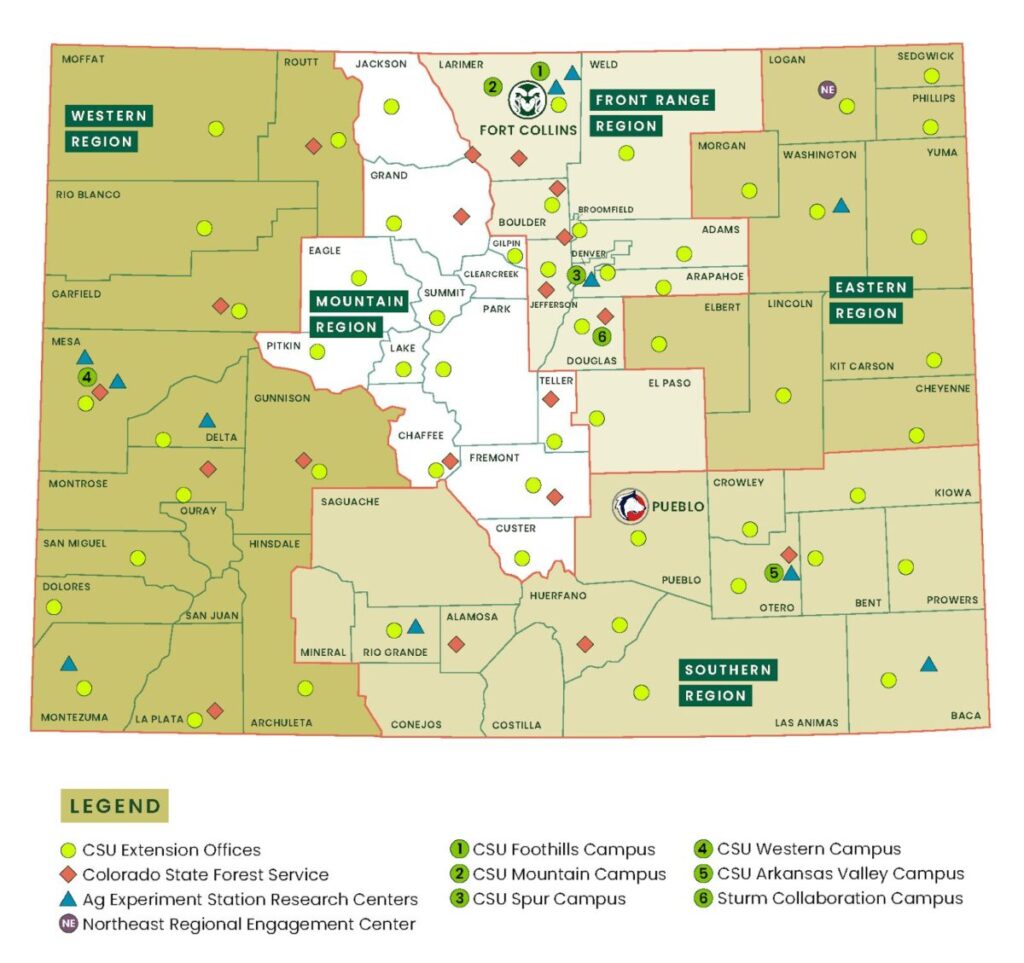
The statewide Extension network includes 63 county offices where local programming is offered by Extension Specialists staffed in each of the county offices (see below). Extension-Library partnerships are a great way to reach new populations, offer educational opportunities in a safe, trusted environment, and engage community residents in activities.
Do the services or resources from your organization cost any money to the participant?
Extension educational programs offered in libraries are free or low-cost. That is determined based on supplies needed and library protocols. Libraries do not need funds to work with Extension. If there is a cost associated with the program(s), the library may choose to pay the cost without passing on expenses to their patrons.
Do libraries have to provide any staff, volunteers, or training in order to run your programs or provide resources or services with your organization?
Library staff is not typically needed. Often, libraries market Extension programs which helps to make them successful.
Let’s say one of our librarians, directors, or staff contact you and says, “We want to bring your organization to our community!” What will the next step look like?
Libraries will likely need to plan ahead a little bit. Room reservations, availability of Extension staff and materials are all factors that will play into how quickly CSU Extension is able to get a program set up.
How can people reach you?
Visit the website to find the CSU extension office closest to you, or reach out to Ginger or Sue!
Ginger Williams, [email protected]
Sue Schneider, [email protected]
- Hidden Gems: Volunteers of America – Colorado - June 17, 2026
- Where in Colorado will the Pigeon Go Next? - June 17, 2026
- Hidden Gems: Tales & Travel - May 14, 2026