
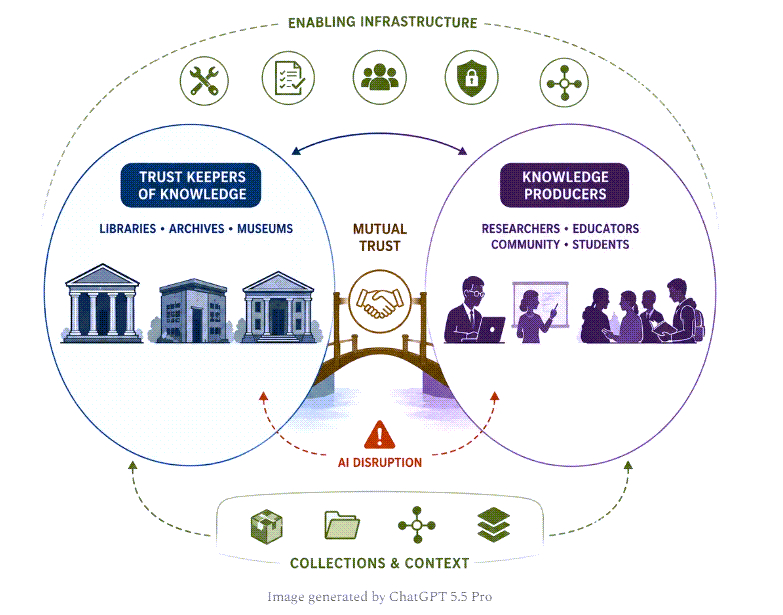
At the end of June, 2026 a group of staff at the Colorado State Library went on a road trip to Laramie WY to attend the Annual AI Summit hosted by the University of Wyoming’s Coe Library. The day-long event consisted of presentations about AI use across many areas of library and information work, but of particular interest to me was the keynote address by Joshua Sternfeld: Preserving Trust in AI Knowledge Ecosystems. In it, Sternfeld addresses one of the most pressing questions facing modern libraries and information professionals: How do we maintain institutional trust in an age dominated by generative AI?. Luckily for everyone who was not able to attend the AI Summit, Sternfeld has transitioned his keynote into a post on his Substack, Encoding the Past.
Rather than treating AI as a passing trend or an outright threat, the post explores the complex intersections of artificial intelligence, archival data, and historical preservation. Sternfeld argues that libraries and cultural heritage organizations must actively shape “AI knowledge ecosystems” to ensure they remain grounded in reliability, deep context, and historical integrity—preventing the erosion of public trust caused by misinformation and unverified digital generation.
As our local communities increasingly transition toward agentic AI tools and digital workflows, this article serves as a wonderful roadmap for how library professionals can step up as crucial anchors of truth and data stewardship.
Read the full post on his keynote remarks on Sternfeld’s Substack.
.png)
- AI Reading Recommendation: Preserving Trust in AI Knowledge Ecosystems - July 22, 2026
- AI Resource Highlight: The Library of Virginia’s Artificial Intelligence LibGuide - July 14, 2026
- Book Club Author Suggestion: David McCullough - July 2, 2026