
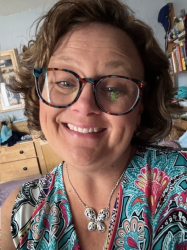
Mary Beth Riedner is the creator of Tales & Travel Memory Programs. She has answered some questions below to help librarians around Colorado learn about their programs.
Below, you will learn about Tales & Travel Memory Programs and their potential to enhance the services you offer to your community’s adult learners.
Tell us who you are and what you do at your organization.
I am the creator of the Tales & Travel Memory Programs. Tales & Travel is an innovative book and reading program that directly serves people living with Alzheimer’s Disease and related dementias.
The programs have won several awards, including Maude’s Awards for Innovation in Alzheimer’s Care (2021), the Library of Congress Literacy Awards Best Practices Honoree (2017), and the Rosalinde Gilbert Innovations in Alzheimer’s Disease Caregiving Legacy Award (2014). The programs have also received grants from the Network of the National Library of Medicine (2015) and from the American Library Association (2013). A recent study (2021) of the program was conducted by Jiamin Dai of McGill University in Canada showing the effectiveness of the program. Details about these awards, grants and studies are available on the Tales & Travel website.
Each Tales & Travel program takes participants on an imaginary trip to another country or region of the United States using library materials, including adult and children’s books, music, and objects. There are two versions of the program:
- The original Tales & Travel Memories program is paper based. Participants take turns reading out loud from a folktale, legend or myth associated with the chosen location. Thirty folktales from locations across the globe are freely available on the Tales & Travel website. Participants are also invited to read aloud from a list of interesting facts about the destination. Finally, they browse through carefully selected books which stimulate memories and spark conversations with other participants as well as with the volunteers and staff conducting the program. Supplementary materials include music, artifacts from the destination, choral reading of poetry, coloring pages, word games and even food, which make the programs multi-sensory.
- The Tales & Travel Adventures digital program was developed in response to the Covid-19 pandemic, when in-person meetings were limited. There are currently 17 digital Adventures available on the website. They take the place of the folk tales and facts of the original Memories program. The Adventures are written in the first person and present tense, in an effort to create a “you-are-there” immersive experience. Slides with large colorful photographs and a narrative filled with facts typed in a large font can be projected on a large screen. Participants take turns reading the slides out loud. Singing of folksongs from the destinations is facilitated by projecting the written lyrics on the screen. The program then provides time for browsing through books, as well as the other activities that make up the original program.
How can your organization partner with a library to offer resources or programming to the local community of library visitors and users?
Tales & Travel started in 2008, but really began to flourish when a partner was found in the Gail Borden Public Library in Elgin, IL in 2011. Within a few years, the Tales & Travel Memories program was being brought to 12 memory care facilities in the Elgin area. Under the leadership of library staff, several grants were obtained to develop a website and conduct a research study into the benefits of the program. Together, the GBPL staff and I began writing articles and presenting at library conferences to inform other librarians about the benefits of the program for those living with dementia. I later brought the Tales & Travel programs to memory cafes in Arizona starting in 2018.
The Tales & Travel programs were designed as a model for other libraries to replicate in their own communities. Colorado libraries can undertake to offer Tales & Travel programs on their own. They may also want to partner with other libraries in their geographic region. Alternatively, Colorado libraries may want to offer to bring Tales & Travel programs to local residential memory communities, memory cafes and adult day centers.
All the resources on the website are freely available for anyone, including public libraries, to use or adapt under a Creative Commons license. Libraries are also encouraged to create their own programs. These programs need not be limited to travel, but could be based on a wide variety of topics.
What needs or challenges can your organization help libraries address for their communities?
People living with dementia are often forgotten when it comes to library service, perhaps due to stigma or lack of information. The Tales & Travel programs provide a way for libraries to bridge that gap. Research has shown that many people living with dementia, especially in the early and middle stages, can still read and enjoy library resources.
In addition to providing “off the shelf” materials, the website contains 12 sample excursion guides and a sample agenda to help libraries plan their own programs. Tips are also provided for choosing appropriate books for the browsing activity.
What regions – cities, counties, areas – of Colorado does your organization reach?
The Tales & Travel programs, as well as all the resources found on its website, can be freely used by anyone at any location around the globe. However, they are all licensed under a Creative Commons license that requires attribution. In addition, any adaptations cannot be used commercially and must be shared with the same licensing restrictions.
Do the services or resources from your organization cost any money to the participant or libraries?
No, all the resources on the website are available at no charge. However, the Creative Commons licensing restrictions mentioned above apply.
Do libraries have to provide any staff, volunteers, or training in order to run your programs or provide resources or services with your organization?
No training specific to Tales & Travel is required. However, libraries are encouraged to provide staff training on how to best interact with those living with dementia. One such training entitled “Dementia Awareness for Public Libraries” has been made available through the Network of the National Library of Medicine – https://www.youtube.com/watch?v=kVNjCnNJ_xc. Other training resources are available through the Alzheimer’s Association, local Area Agencies on Aging, local research hospitals, and Dementia Friendly America.
Let’s say one of our librarians, directors, or staff contact you and says, “We want to bring Tales & Travel to our community!” What will the next step look like?
Libraries can proceed on their own without any need to contact Tales & Travel. However, I would be happy to answer questions. I can be reached at [email protected].
- Hidden Gems: Volunteers of America – Colorado - June 17, 2026
- Where in Colorado will the Pigeon Go Next? - June 17, 2026
- Hidden Gems: Tales & Travel - May 14, 2026